

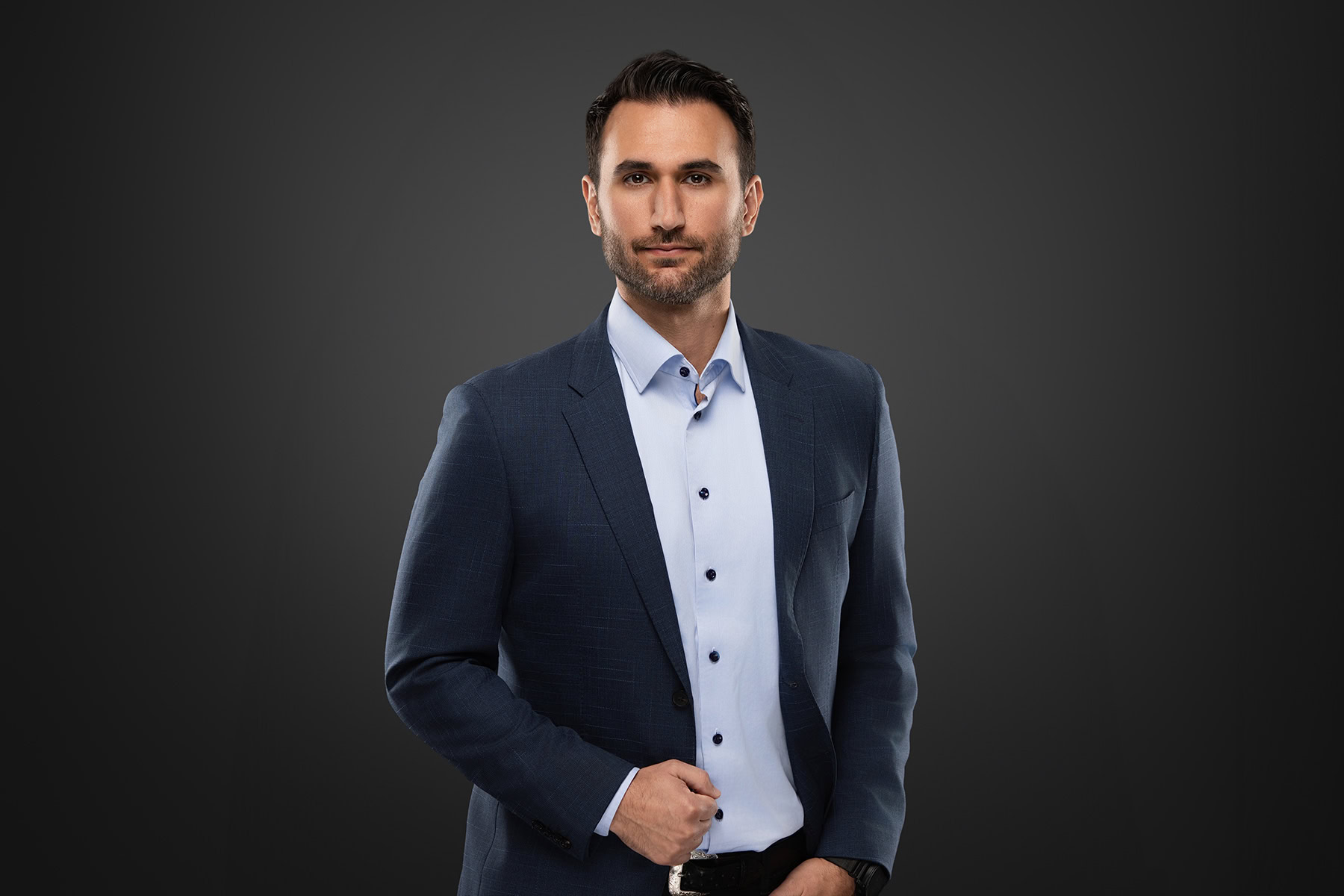
Headshots for Denver Law Firms and Financial Services Teams
Everything attorneys, advisors, and firm marketing leads need to know, including the compliance rules most headshot guides skip.


Group Law Firm Photo / Denver Headshot Co.
A note before we start. This article includes general information about advertising and communications rules that can apply to attorneys and financial professionals. It is not legal or compliance advice, and it is not exhaustive. We are photographers, not counsel. Route every published image and bio page through your firm’s ethics counsel or chief compliance officer.
If you sell trust for a living, your headshot is not decoration. It is one of the first pieces of evidence a prospect evaluates about whether you are competent and whether you are safe to hand a problem to.
There is research worth knowing here. In a 2006 study published in Psychological Science, Janine Willis and Alexander Todorov found that trait judgments: trustworthiness, competence, likeability, attractiveness, aggressiveness, formed after a 100-millisecond exposure to an unfamiliar face correlated highly with judgments made after unlimited viewing time. Longer exposure didn’t meaningfully improve that correlation; it mostly increased participants’ confidence in the impression they had already formed. Two nuances the popular version of this study usually drops: from 100 to 500 ms, judgments became somewhat more negative and more differentiated.
That’s a lab finding about ratings of strangers’ faces, not necessarily a measurement of who gets hired or retained. But the direction is hard to ignore if your bio photo is the first thing a prospect sees: an impression is forming well before your practice description gets read.
Legal and financial services headshots also face a constraint that almost no other industry has: the image usually sits within a regulated communication. Attorney bio pages are generally governed by the Rules of Professional Conduct. Broker-dealer representative pages generally fall under FINRA Rule 2210. Registered investment adviser pages generally fall under the SEC Marketing Rule. Most headshot advice ignores this entirely. We won’t.
This guide is split into three parts: what individual professionals need, what firm decision-makers need, and what compliance needs.
Part 1: For the Individual Attorney, Advisor, or Accountant
Match the expression to the practice area, not to a generic “look approachable” rule

The standard headshot advice to smile, look friendly, is too blunt for this industry. Here is how we think about direction by practice area. This is our studio’s philosophy from a decade of shooting legal and financial clients:
- Litigation, criminal defense, plaintiff-side work: Clients are frightened and want a fighter. A closed-mouth, level-eyed expression with a slight forward lean tends to read as resolve. A wide social smile can pull against it.
- Family law, estate planning, elder law, personal injury intake: Clients are in distress and are choosing a person, not a firm. Warmth matters more here than authority.
- Wealth management, financial planning, RIA advisory: The buyer is evaluating stewardship. The target is calm, steady, and unhurried, not salesy, not stern. Think “the person who will tell me the truth about my portfolio.”
- Corporate/transactional, tax, audit, institutional finance: Clean, controlled, minimal styling. Understatement is the signal.
In practice, the answer for most people is to shoot both a warm frame and an authoritative frame in the same session and use them in different places. A good photographer will direct you into both rather than leaving you to figure it out.
What to wear
The wardrobe rules for this industry are tighter than for tech or creative fields:
Do:
- Solid, mid-to-dark tones such as navy, charcoal, deep gray, forest green, burgundy. These read as authoritative on nearly every background.
- Structured layers. A jacket or blazer creates shoulder line and vertical structure that a knit top can’t. Even in business-casual firms, the jacket photographs more decisively.
- Well-pressed and correctly fitted. Fit is more visible in a headshot crop than fabric quality is.
- Bring two to three options. Lighting and background interact with color in ways that are hard to predict in advance.
Don’t:
- Tight patterns such as pinstripes, small checks, herringbone. They can produce moiré artifacts at web resolution.
- High-contrast white shirts with no jacket. They blow out and pull the eye off your face.
- Transition lenses. They darken under studio strobes and hide your eyes, which is the single most important part of a trust-signaling portrait. Bring frames with the lenses removed, or an identical non-transition pair.
- Anything that aggressively dates the image, such as very wide lapels, loud ties, or statement jewelry. You want this photo to hold up for the full two-to-three-year life of a headshot.
For a deeper breakdown, see our What to Wear guide.

Denver has its own dress code, and it’s not New York’s
This matters more than most national guides admit. Denver’s legal and financial corridors, the 17th Street financial district, Downtown/LoDo, Cherry Creek, and the Greenwood Village and Denver Tech Center wealth-management cluster, run meaningfully more business-casual than Manhattan or Chicago.
A full three-piece suit and tie can read as out of market on a Denver firm’s team page while reading as perfectly normal in New York. Conversely, an open-collar look with no jacket may read as too loose for a Denver litigation boutique that competes against national firms.
The safe play: jacket on, tie optional, and shoot a few frames both ways.
Crop and framing: build one file that works everywhere
Legal and financial professionals need the same face in more places than most people:
| Placement | Practical requirement |
|---|---|
| Firm bio page | Often a fixed crop set by the site template; ask marketing for the ratio before you shoot |
| Circular crop; anything below the collarbone gets cut | |
| Email signature | Tiny, typically 80–150px; needs to survive extreme downscaling |
| CRM / directory profiles | Square, often auto-cropped |
| Speaking bios, panel decks, press | Frequently need a wider crop with headroom |
The fix is to shoot with margin, capture a mid-chest frame you can crop into, and to ask your photographer for both a tight square and a looser vertical from the same setup. See Headshots for LinkedIn, Email Signatures, and CRM Profiles for the specifics.
The AI headshot problem is a bigger risk here than anywhere else
AI headshot generators are cheap and fast, and for a graphic designer or a software engineer the downside of using one is mostly aesthetic.
For a licensed attorney or a registered advisor, the calculus is different. A generated or heavily AI-altered portrait that makes you look materially unlike the person who walks into the deposition, the client meeting, or the arbitration is not just awkward, it is a representation about you, published on a page that offers your professional services. That is the kind of communication the advertising rules are written to reach. (More on the specific rules in Part 3.)
There is also a practical failure mode that has nothing to do with regulators: AI tools can alter bone structure, skin tone, and hairlines in ways that are obvious side by side. Opposing counsel, a compliance examiner, or a prospective client comparing your bio photo to your LinkedIn video is not a hypothetical audience.
A defensible conservative standard for this industry: the photo should be a real photograph of you, retouched only to the level of removing temporary blemishes and stray hairs. Nothing structural.
How often to update
Every two to three years, and immediately after any significant change in appearance, such as hair color or length, glasses, weight change, facial hair, promotion to a role with a different visual expectation.
An out-of-date headshot creates a small credibility gap at the exact moment you want none. If the person who greets a client at the conference room door doesn’t match the photo they clicked, you’ve spent trust you didn’t need to spend.
Part 2: For Firm Marketing, HR, and Operations Leads
If you’re responsible for a 12-attorney boutique or a 200-person advisory firm, your problem is not artistry. It’s variance and logistics.
Consistency is the actual deliverable
In our experience, the usual failure on a law firm or RIA team page isn’t a bad headshot. It’s twenty decent headshots that don’t match. A different background, different crop heights, different color temperatures, different eras. It signals institutional sloppiness to the audience that is screening you for institutional rigor.
The variables:
- Background. One background across the whole roster. Pick it according to your brand palette and your site’s layout. Our background options page covers the tradeoffs.
- Crop ratio and eye-line height. The eyes should land at the same height in every image. This is the single most visible consistency cue on a grid.
- Lighting pattern. Same key light position and ratio for everyone.
- Retouching standard. Written down. “Remove temporary blemishes and stray hairs; no reshaping, no skin smoothing beyond X” so you get the same result whether the subject is a name partner or a first-year associate.
- Posing convention. Seated vs. standing, arms in vs. out, body angle. Pick one.
Do the billable-hour math before you choose studio vs. on-site
This is the calculation firms most often skip. Sending 30 attorneys to an off-site studio individually costs you:
- Travel time in both directions
- Scheduling coordination and no-show rework
- Lost billable or production hours during the trip
Run your own numbers. As an illustration only: a 90-minute round trip per attorney across 30 attorneys is 45 hours of lost capacity. At an assumed blended rate of $350/hour, that’s roughly $15,750 in opportunity cost, often larger than the photography line item itself. Substitute your firm’s actual realization rate and travel time; the point is that the invoice is not the whole cost.
An on-site session with a mobile studio reduces that to 10 – 15 minutes per person in the building, with people cycling between meetings. For firms with a downtown Denver, DTC, or Cherry Creek office, this is frequently the cheaper option on total cost even when the photography invoice is higher.
The counter-case: if your team is distributed, hybrid, or under 10 people, individual sessions at a fixed studio can be simpler to administer.
Solve for roster churn before it happens
Legal and financial services firms have constant lateral movement, summer associate classes, and new advisor onboarding. If you do one big shoot and no follow-up plan, your team page degrades within six months, and the newest hires, who most need to look established, look like afterthoughts.
Build a maintenance path from day one:
- Lock and document the exact lighting, background, and crop specs from the original session
- Set a standing cadence for new hires (quarterly is typical; monthly for high-growth firms)
- Confirm your photographer can reproduce the original setup closely, this is what our Company Match service exists to do
Get your file delivery right the first time
Ask for, at minimum:
- Full-resolution TIFF or high-quality JPEG masters, archived
- Web-optimized derivatives sized to your CMS template, in WebP where supported
- Square and vertical crops from the same master
- Consistent file naming: lastname-firstname-headshot-2026.jpg, because you will need to find these again during a compliance review or a website migration
- Written license terms covering website, social, print collateral, press, and recruiting use
That last one matters more in regulated industries than elsewhere. See Part 3.
Part 3: The Compliance Layer
Repeating the note from the top: this section is general information for planning purposes, not legal or compliance advice, and it is not a complete survey of the applicable rules. Send every published image through your firm’s ethics counsel or compliance officer before it goes live.
Here is the part almost every headshot guide leaves out: in legal and financial services, the photo on your bio page is generally part of a communication that a regulator can review.
If you’re an attorney: the Rules of Professional Conduct apply to your bio photo
Colorado Rule of Professional Conduct 7.1 — repealed, readopted, and effective September 10, 2020, states in full:
“A lawyer shall not make a false or misleading communication about the lawyer or the lawyer’s services. A communication is false or misleading if it contains a material misrepresentation of fact or law, or omits a fact necessary to make the statement considered as a whole not materially misleading.”
Comment [1] to the rule makes the scope explicit: “This Rule governs all communications about a lawyer’s services, including advertising. Whatever means are used to make known a lawyer’s services, statements about them must be truthful.”
Comment [2] goes further, and this is the sentence that matters for imagery: “A truthful statement is misleading if a substantial likelihood exists that it will lead a reasonable person to formulate a specific conclusion about the lawyer or the lawyer’s services for which there is no reasonable factual foundation.”
Practical translation for headshots:
- AI-generated or structurally altered portraits invite exactly the argument the rule contemplates.
- Staged “courtroom” or “office” imagery that depicts something that isn’t your practice, a borrowed conference room, a stock courtroom, models standing in for staff, is worth flagging to your ethics counsel.
- Non-lawyer staff photographed on an attorney bio grid without a role label can imply lawyer status. Label everyone.
- Uniform styling that implies a firm size or structure you don’t have: For example, a solo practitioner photographed as a “team” is a real risk area.
A housekeeping note for Colorado firms. Colo. RPC 7.4 (Communication of Fields of Practice) and Colo. RPC 7.5 (Firm Names and Letterheads) were both repealed and reserved effective September 10, 2020. Their substance was redistributed: firm names, letterhead, and professional designations are now addressed in Comment [5] to Rule 7.1, while the specialist-certification restrictions moved to Colo. RPC 7.2 (“Communications Concerning a Lawyer’s Services: Specific Rules”). Any online guidance still citing Colorado Rule 7.4 or 7.5 is out of date, and if your bio page pairs a headshot with a “specialist” or board-certification claim, Rule 7.2 is the provision to read alongside 7.1.
If your firm is multi-jurisdictional, treat the strictest applicable state as your working standard. Colo. RPC 8.5 governs the actual choice-of-law analysis. But practically: your Denver-shot images will appear on a page visible in every state you practice in, and some states impose advertising requirements Colorado does not. Have counsel identify which ones apply to you.
If you’re a registered rep at a broker-dealer: FINRA Rule 2210
Under FINRA Rule 2210(a)(5), a “retail communication” is any written (including electronic) communication distributed or made available to more than 25 retail investors within any 30 calendar-day period. A public-facing firm website or advisor bio page will typically clear that bar.
What generally follows from that classification:
- Principal pre-approval. Rule 2210(b)(1)(A) requires that an appropriately qualified registered principal approve each retail communication before the earlier of its use or filing with FINRA’s Advertising Regulation Department. There are exceptions in (b)(1)(C)–(E), but in practice, expect principal review before a new bio page goes live.
- Recordkeeping. Rule 2210(b)(4)(A) requires members to retain retail communications for the period required by SEA Rule 17a-4(b) not less than three years, the first two in an easily accessible place, in a format and media that comply with 17a-4. The record must include a copy of the communication, the dates of first and (if applicable) last use, and the name of the principal who approved it and the date approval was given.
- New-member pre-filing. Rule 2210(c)(1)(A) requires firms, for one year from the date reflected in CRD as the FINRA membership effective date, to file certain retail communications with the Department at least 10 business days prior to first use, including material published on any generally accessible website. Newly formed broker-dealers should build that lead time into the photo shoot calendar.
Operational consequence: budget lead time. A firm that schedules a shoot for Monday and needs the site live Wednesday has not accounted for principal review.
If you’re an SEC-registered investment adviser: the Marketing Rule
Rule 206(4)-1 under the Investment Advisers Act of 1940 defines an “advertisement” broadly. The first prong covers any direct or indirect communication an adviser makes to more than one person that offers the adviser’s investment advisory services with regard to securities to prospective clients or private fund investors, or offers new such services to current clients or investors, subject to carve-outs for extemporaneous live oral communications, required regulatory filings, and certain hypothetical-performance communications. A second prong captures compensated endorsements and testimonials. A public advisor bio page on a firm site that offers advisory services will typically fall inside the first prong.
The general prohibitions that touch imagery:
- 206(4)-1(a)(1): No untrue statement of a material fact, and no omission of a material fact necessary to make the statement not misleading.
- 206(4)-1(a)(3): No information “that would reasonably be likely to cause an untrue or misleading implication or inference to be drawn concerning a material fact relating to the investment adviser.”
- 206(4)-1(a)(7): The advertisement may not “otherwise be materially misleading.”
Paragraph (a)(3) is the one to sit with. It is not limited to statements, it covers information likely to cause a misleading inference. Imagery that implies scale, credentials, or an institutional footprint the firm doesn’t have lives in that zone.
Two adjacent traps on the same page as your headshot:
- Testimonials and endorsements — 206(4)-1(b). A “testimonial” under 206(4)-1(e)(17) is a statement by a current client or investor — so a standalone client photo isn’t one, but a client statement, and any photo presented with it, is. Those trigger clear-and-prominent disclosure requirements: whether the person is a current client, whether compensation was provided, and any material conflicts of interest. Paragraph (b) also imposes written-agreement and oversight obligations at (b)(2) and disqualification limits at (b)(3). There are exemptions — including for testimonials by the adviser’s own partners, officers, directors, or employees where the affiliation is readily apparent or disclosed and the adviser documents that person’s status, but they are conditional, not automatic.
- Third-party ratings — 206(4)-1(c). That “Top 100 Advisors” badge next to a headshot carries two requirements. Under (c)(1), the adviser must have a reasonable basis for believing the underlying questionnaire or survey was structured to make favorable and unfavorable responses equally easy to give and was not designed to produce a predetermined result. Under (c)(2), the adviser must clearly and prominently disclose the date the rating was given and the period it was based on, who created and tabulated it, and, if applicable, that compensation was provided directly or indirectly in connection with obtaining or using it.
Retention: Advisers Act Rule 204-2(a)(11) requires advisers to keep a copy of each advertisement, and Rule 204-2(e)(3)(i) sets the period at not less than five years in an easily accessible place, the first two years in an appropriate office of the adviser, running from the end of the fiscal year in which the communication was last published or disseminated. Note: (a)(11) is expressly excepted from 204-2(e)(1), a cite you will see used incorrectly online. Practically, that means the published page and the images on it, so keep your masters archived rather than relying on the photographer’s storage.
The pre-shoot compliance checklist
Before you book:
Confirm who has approval authority: ethics counsel, CCO, or a registered principal, and their turnaround time
Get the retouching standard in writing before the shoot
Confirm no AI generation or structural alteration will be used
Confirm your image license covers every intended surface: website, LinkedIn, print, press, recruiting, third-party directories
Confirm how long the photographer archives masters, and that you hold archived copies for your retention period
Confirm role labels for non-licensed staff appearing on the same page
For multi-state firms: identify the strictest applicable jurisdiction and comply with it
Build principal/compliance review time into the launch date and not the shoot date
Denver-Specific Practicalities
Where your people actually are. The 17th Street corridor, LoDo, and Cherry Creek concentrate the legal and banking side; Greenwood Village, the Denver Tech Center, and Lone Tree concentrate wealth management and RIAs. On-site sessions eliminate cross-town travel that can eat 45–90 minutes per person during Denver business hours.
Altitude and skin. Denver’s dry air and elevation produce visibly drier skin than most photographers plan for. Hydrate the day before, use moisturizer the morning of, and expect a competent studio to have blotting sheets and a hair-and-makeup option on hand.
Seasonal light. If any portion of your session uses window light, note that Denver’s low winter sun angle and high summer contrast produce meaningfully different results. Controlled studio lighting removes the variable entirely, which matters when you’re matching a roster shot over time — a January new-hire needs to match a July original.
Frequently Asked Questions
The regulatory answers below are general information, not legal or compliance advice. Confirm with your ethics counsel or CCO.
How much do law firm headshots cost in Denver? Professional headshots in Denver generally range from about $150 to over $500 per person. Team and firm-wide sessions are typically priced per person on a sliding scale, with on-site sessions often reducing the effective total cost once staff travel time is accounted for. Request a quote based on headcount, location, and whether you need matched retakes for future hires.
Can attorneys use AI-generated headshots? It is not advisable. Attorney bio pages are communications about a lawyer’s services governed by Rule 7.1 of the Rules of Professional Conduct, which prohibits false or misleading communications. An AI-generated or structurally altered portrait that does not accurately depict the attorney invites exactly that analysis. Consult your firm’s ethics counsel before publishing any AI-generated imagery.
Does my financial advisor headshot need compliance approval? Usually, yes. If you are a registered representative of a broker-dealer, a public bio page is generally a “retail communication” under FINRA Rule 2210 and requires registered principal approval before use. If you are with an SEC-registered investment adviser, the bio page generally falls within the “advertisement” definition under Rule 206(4)-1. Check with your CCO before publishing.
How often should attorneys and advisors update their headshots? Every two to three years, and immediately after any material change in appearance. In trust-driven professions, a photo that no longer matches the person creates a credibility gap at first contact.
What should a financial advisor wear for a headshot? Solid mid-to-dark tones — navy, charcoal, deep gray — with a structured jacket. Avoid tight patterns that can cause moiré at web resolution, and avoid transition lenses that darken under studio lighting and hide your eyes. Denver’s financial corridor runs somewhat more business-casual than East Coast markets; a jacket with an optional tie is the reliable middle.
Should our whole firm use the same background? Yes. Background consistency across a team page is one of the most visible signals of institutional rigor, and in our experience inconsistency is the most common defect we see on law firm and advisory team pages. Lock the background, crop ratio, eye-line height, and lighting pattern before the first frame, and document them so future hires can be matched.
Book Your Firm’s Session
Denver Headshot Co. has photographed legal and financial services teams across the metro since 2014, from downtown litigation boutiques to DTC advisory firms. We shoot at our RiNo studio or bring our mobile studio to your office, and our Company Match service reproduces your original setup so new hires don’t look like an afterthought.
- Professional Headshots for Lawyers →
- Corporate & Team Headshots →
- Individual Headshots →
- See the portfolio →
Get a quote → or call (720) 799-2655.
Sources
Colo. RPC 7.1, Communications Concerning a Lawyer’s Services (Colorado Bar Association)
FINRA Rule 2210, Communications with the Public
17 CFR 275.206(4)-1, Investment adviser marketing (eCFR)
17 CFR 275.204-2, Books and records to be maintained by investment advisers (eCFR)
17 CFR 240.17a-4, Records to be preserved by certain exchange members, brokers and dealers
Jackie, the founder and creative director at Denver Headshot Co., brings over a decade of experience in professional photography to her role. Her extensive expertise, combined with a genuine passion for capturing the essence of her clients, has been instrumental in establishing Denver Headshot Co. as a leader in the field. Under her guidance, the company is renowned for its commitment to quality and authenticity, providing headshots that not only showcase the individuality of each client but also amplify their professional presence. Jackie’s experience, leadership, and artistic vision ensure that every client receives a personalized and empowering photography experience.
Related articles
How AI Headshots Affect Perceived Authenticity Online
The Visual Impact of Consistent Headshots