
How AI Headshots Affect Perceived Authenticity Online
If someone clicks your profile, do they feel like they just met you, or like they just met a polished version of you that might not show up on the call?
Online, your headshot does a quiet job before you ever speak. It sets expectations. It signals how you want to be seen. And for many people, it plays a role in one core question, can I trust this person enough to keep reading, book a consultation, or send a message?
Table Of Contents
- 1. Why Authenticity Starts With Recognition
- 2. How AI Headshots Can Undermine Trust
- 3. Why a Real Headshot Still Wins (And What To Do Instead of AI)
- 4. Conclusion
- 5. FAQs
AI headshots can help you look put together fast. They can also create a subtle sense of distance, even when the image is technically “good.” Viewers do not need to prove an image is synthetic to feel less certain about it. That uncertainty often shows up as hesitation, and hesitation is where clients drift away.
In this guide, we will break down how perceived authenticity works in headshots, what tends to damage it, and what you should do if you choose to use an AI image anyway. Along the way, we will share a few real-world ways people keep their visuals honest without settling for a sloppy photo.
Why Authenticity Starts With Recognition
Authenticity online is not a formal verdict. It is closer to a first impression that keeps updating. People scan quickly, then they decide whether the rest of your profile feels consistent with the person in the photo.
Recognition is the foundation of that consistency. A headshot should help people recognize you in three situations.
- When they see you again on a different platform
- When they see you in a video call
- When they meet you in person, even briefly
AI headshots tend to struggle most with the second and third situations. If your face looks noticeably different when the camera turns on, the mismatch can feel like a small breach of trust. Not always dramatic, but enough to make someone wonder what else has been “optimized.”
Here is a question we use when reviewing any headshot, AI or not. If you showed up to a meeting with a new client tomorrow, would they feel instantly oriented, or would they need a second to reconcile your photo with your real face?
That moment of reconciliation is where perceived authenticity takes a hit.
What People Check In A Face Photo
Most people are not judging lighting ratios or lens choice. They are picking up on human cues. Some of these cues are conscious, many are not.
They tend to look for:
- A face that feels believable in texture and proportion
- An expression that matches the role you claim to have
- A style that fits the context of your work
- A level of polish that suggests effort, not disguise
The “effort versus disguise” line matters more than many people expect. A clean, well-made photo usually helps. An image that looks too perfect can raise a quiet red flag. It can read as generic, overly curated, or strangely impersonal.
And authenticity is personal. If your photo feels like a character template, it can make you feel less knowable, even if you look impressive.
Another question worth asking. If your headshot appeared next to a comment you wrote, would it feel like the same person wrote it?
How AI Headshots Can Undermine Trust
AI headshots influence perceived authenticity mostly through one mechanism. They can change identity cues, not just presentation cues.
Presentation cues are things like flattering light, good posture, a neutral background, and a calm expression. Identity cues are things like face shape, age signals, skin texture, and the specific quirks that make you recognizably you.
When an AI headshot drifts into changing identity cues, it can create doubt in a few common ways.
- It makes you look like someone else’s idea of you
Many AI tools push toward a similar aesthetic. Smooth skin, bright eyes, perfect symmetry. It can look “nice” while also feeling oddly interchangeable. Interchangeable does not help you stand out to clients who are choosing a person, not a logo. - It creates an expectation you cannot comfortably meet
If your headshot suggests a different age, a different fitness level, or a different bone structure, it becomes a future honesty test. Even a mild mismatch can be distracting when the relationship is just beginning. - It conflicts with your real-life context
Your headshot is not only your face. Clothing, background, and general vibe are part of the message. If you work with local businesses in a casual setting and your headshot reads like a glossy tech keynote promo, the mismatch can make people pause. - It can look like you are hiding
Sometimes the image is not wildly altered, but the overall feel is too “manufactured.” That can trigger a simple suspicion. If the photo is processed, what is the person trying to control?
We have seen people choose AI headshots because they feel time-starved, camera-shy, or unsure about how to look professional. Those are valid reasons. But the fix should not introduce a new problem. Your photo should reduce friction, not add it.
If you are unsure whether an AI headshot is crossing the line, ask a blunt question. Would you feel comfortable showing this image to someone who already knows you well, without explaining anything first?
If you would need to explain, the image is probably too far from reality.
The Subtle Cues That Trigger Doubt
Most viewers cannot list technical flaws. But they often feel them.
Here are some subtle cues that commonly make an AI headshot feel less authentic.
- Skin that looks airbrushed instead of human
Real skin has texture. Even with retouching, it should still look like skin. When it turns into a smooth gradient, people read it as heavy filtering. - Lighting that does not behave naturally
If highlights and shadows do not line up across the face, neck, and clothing, something feels off. Your brain is good at spotting inconsistent light. - Eyes that look too crisp or oddly flat
Eyes are where attention goes first. When catchlights look strange, the gaze does not feel grounded. The entire image can start to feel “printed” rather than alive. - Edges that look slightly artificial
Hairlines, glasses, shoulders, and collars often show tiny artifacts. Even if the viewer cannot name it, they may feel that something is synthetic. - A smile that looks perfect but not personal
A natural smile has small asymmetries. Perfect teeth and perfectly even expression can read as staged in a way that feels less relatable.
Here is another creative test. If your headshot were on a name tag at an event, would someone confidently walk up to you and say your name? Or would they hesitate because the photo looks like a different person? That hesitation is the authenticity cost.
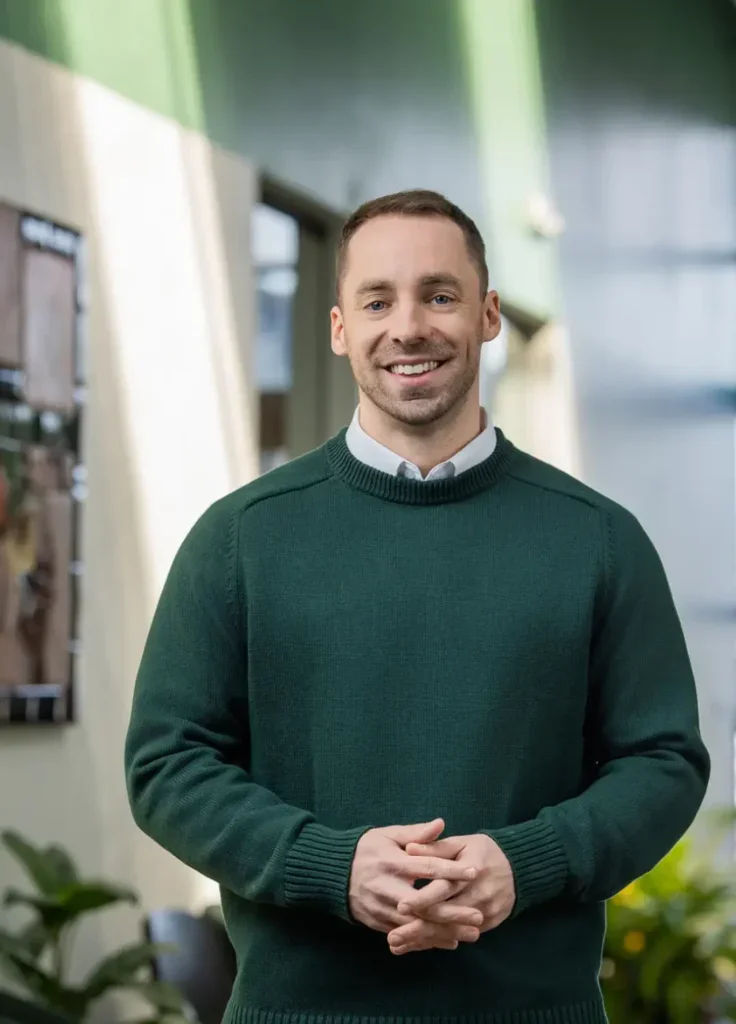
Why a Real Headshot Still Wins (And What To Do Instead of AI)
We are not here to pretend AI headshots are the only problem in modern branding. The bigger issue is what they replace: a real, credible photo that people can trust.
If your work depends on relationships, referrals, or first impressions, your headshot is not just decoration. It’s a trust signal. And trust is hard to build and easy to lose.
AI headshots create a “comparison moment”
Even when an AI image looks “professional,” it often creates a subtle gap between the person people expect and the person they meet. That gap is what makes audiences hesitate. They may not call it out, but they feel it.
The risk is not only that the image looks fake. The risk is that it looks too polished, too generic, or slightly “off” in a way that makes you feel less human and less believable.
A photographer solves the real problem: looking like yourself, at your best
Most people use AI because they want a better photo quickly, or because they don’t feel photogenic. A good headshot photographer handles both, without changing who you are.
A real session gives you:
- Guidance (so you don’t look stiff or unsure)
- Consistency (lighting, angles, expression, wardrobe)
- A face people recognize (you, on your best day—not a new person)
- Retouching that stays honest (polished, not plastic)
Real headshots work because they match real life
A strong headshot is not about perfection. It’s about alignment: when someone sees your photo, then meets you, the story stays consistent. That consistency is what builds confidence. Make sure to follow the list below:
- 1. work with a photographer who coaches expression and posture.
- 2. choose wardrobe you actually wear when meeting clients
- 3. ask for realistic retouching that keeps skin texture and defining features
- 4. don’t chase a “flawless” look that makes you feel generic
- 5. don’t pick styling you can’t recreate in real life
- 6. don’t treat your headshot like a reinvention; it should be recognizable
Two quick tests (for any headshot you use)
The thumbnail test
Most platforms show your photo as a small circle. Shrink it down. If it turns into a generic “professional person” icon instead of your face, it’s not doing its job.
The video call test
Open your laptop camera and compare your live face to the headshot. If you’d feel awkward about the difference, that’s your answer.
Now, here is the part many people skip. If you dislike being photographed, you do not need perfection. You need a process that makes you look like yourself while still looking prepared. That is exactly what a good photographer provides: direction, comfort, and a final image that feels authentic, because it is.
If you want a clear sense of what that process looks like, you can glance at the homepage of Denver Headshot Co. and notice how consistent styling and realistic retouching can keep personality intact without turning anyone into a different person. We also describe what an individual headshot session includes, which is helpful if your main concern is looking authentic on platforms where people will meet you quickly. And if your online presence needs more than one image, you should consider personal branding to understand how photos can stay consistent across your site, your social profiles, and your marketing; without relying on synthetic perfection.
Conclusion
AI headshots affect perceived authenticity online because they can introduce doubt, even when the image looks polished. If the headshot feels generic, too perfect, or too different from you, people often pause. If your work depends on relationships and referrals, that pause can be the difference between a message and a silent scroll.
A realistic, well-made photo is usually the simplest way to reduce that friction. When we create professional headshots, the goal is not to hide who you are. It is to make sure the version people meet on screen matches the person they meet in real life
FAQs
Can people tell an AI headshot is AI generated?
Sometimes, but more often they just sense something feels off. The trust impact usually comes from that feeling, not from certainty.
Is it risky to use an AI headshot when you work with clients?
It can be, especially if you meet people on video calls or in person. If the photo does not look like you, the mismatch can create doubt early in the relationship.
What is the biggest mistake people make with AI headshots?
Choosing an image that changes identity cues, like face shape, age signals, or defining features. That is where authenticity breaks.
How close should an AI headshot be to your real appearance?
Close enough that someone who knows you would say “yes, that is you” immediately, without qualifiers.
What should you do if you already uploaded an AI headshot that feels off?
Replace it with a recent, realistic photo as soon as you can. If you keep the AI version, choose one that matches your current look and avoid overly perfect edits that make you look generic.
Look Authentic Online With Polished, On-Brand Headshots
→ Guided, fast sessions so you look confident and natural (not stiff or “AI”).
→ Consistent, on-brand photos across LinkedIn, your website, and listings.
→ Modern headshots done right, updated, professional, and trust-building.
★★★★★ Rated 5/5 by Over 430 Satisfied Clients in Specialized Industries

Jackie, the founder and creative director at Denver Headshot Co., brings over a decade of experience in professional photography to her role. Her extensive expertise, combined with a genuine passion for capturing the essence of her clients, has been instrumental in establishing Denver Headshot Co. as a leader in the field. Under her guidance, the company is renowned for its commitment to quality and authenticity, providing headshots that not only showcase the individuality of each client but also amplify their professional presence. Jackie’s experience, leadership, and artistic vision ensure that every client receives a personalized and empowering photography experience.
Related articles
The Ultimate Guide to Business Portraits in Denver
The Power of Being Real: Why Authenticity Wins in a Digital World